
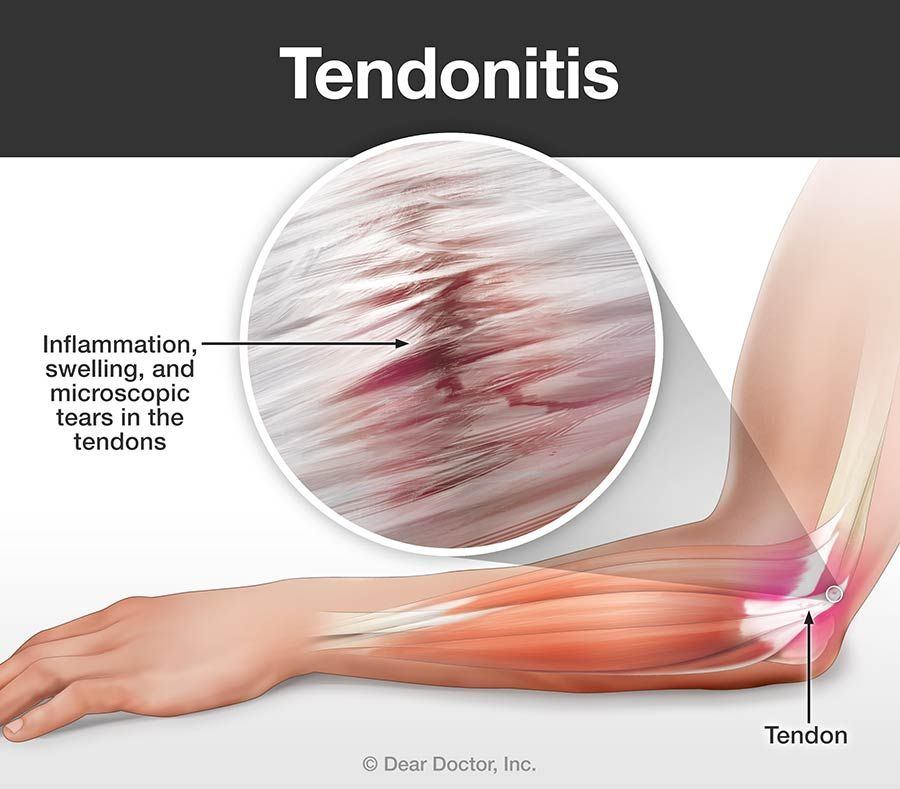
Tendonitis is inflammation or irritation of a tendon, the strong band of tissue that links a muscle to a bone. It most often affects the elbows, wrists, knees and heels, although it can develop in any tendon in the body.
Tendons are tough yet flexible. Some are small and fine, like those in the fingers, while others are thick and cord-like, like those in the thigh. Tendonitis usually develops from overuse, such as repeating the same throwing motion again and again or ramping up activity too quickly when starting a new workout routine. Warming up and stretching before activity may help lower the risk by improving flexibility and preparing tissues for movement.
Several familiar complaints are actually forms of tendonitis, including "tennis elbow," "golfer's elbow," "pitcher's elbow" and "jumper's knee." Athletes are not the only ones affected. Gardening, carpentry, housework and other repetitive tasks can also irritate tendons. Without proper care, tendonitis may become a long-term problem or lead to other injuries, so early attention is often worthwhile.
Signs and Symptoms
Tendonitis typically causes pain in the area around a joint. The joint may also feel weak, and the skin over it may appear red, swollen or warm. Symptoms vary depending on which tendon is involved:
- Shoulder tendonitis, sometimes nicknamed "swimmer's shoulder" or "pitcher's shoulder," involves the rotator cuff, a group of muscles and tendons that keeps the shoulder stable. When these tendons are overworked or pinched, they may produce a dull ache that spreads into the upper arm and often gets worse at night, sometimes interfering with sleep. Swelling, weakness and reduced shoulder movement may also occur.
- Tennis elbow produces pain along the outside of the elbow that may travel toward the wrist. It occurs when the forearm tendons become strained and inflamed where they attach to the bony prominence on the outer elbow.
- Golfer's elbow causes pain along the inside of the elbow. It involves inflammation where forearm tendons attach to the bony bump on the inner elbow, and discomfort may extend into the forearm and wrist. Pitcher's elbow is a related condition affecting other tendons on the inner side of the elbow.
- Jumper's knee is pain around the knee that is common among basketball and volleyball players. It involves the tendon connecting the kneecap (patella) to the shinbone (tibia). Pain is usually felt just below the kneecap, though it can sometimes be felt slightly above it.
- De Quervain's tenosynovitis, also called De Quervain's disease, causes pain near the base of the thumb. Twisting the wrist, gripping objects or making a fist may be uncomfortable. It may result from repetitive hand or wrist motions, such as video gaming or racquet sports, or from a direct injury to the thumb.
- Achilles tendonitis causes pain at the back of the heel or just above it. The Achilles tendon joins the calf muscles to the heel bone. Runners who suddenly increase their mileage or intensity are especially prone to it, and shoes that fit poorly may raise the risk.


Managing Tendonitis
Reducing use of the affected area is usually an important first step, and healing can take several weeks. Chiropractic care offers a conservative, drug-free option that some patients find helpful in supporting recovery without steroid injections or surgery. Chiropractors may use adjustments along with soft tissue techniques intended to reduce inflammation, address scar tissue and help restore normal movement.
Care may also include therapies such as low-level laser or electrical stimulation, which some practitioners use to support tissue repair, and in some cases a chiropractor may discuss nutritional supplements. When scar tissue or adhesions limit movement, manual techniques may help loosen them and encourage blood flow to the area. Rehabilitative exercises are often added as healing progresses. A tendon injury that involves a sudden pop, inability to move the joint or severe swelling should be evaluated promptly by a medical provider, as it may indicate a tear. People with ongoing tendon pain may want to discuss their options with a chiropractor or other healthcare provider.