
Scoliosis is a condition in which the spine curves to the side, forming a shape that resembles a "C" or an "S." It most often appears during a growth spurt in childhood or the teen years, and it tends to be more common in girls than in boys.
In some cases, scoliosis is linked to an underlying neurological, muscular or connective tissue disorder. More often, though, no clear cause is found, although the condition does appear to run in families. Many people with scoliosis have few or no problems, but for others it can lead to persistent pain and tiredness, particularly later in life.
Signs and Symptoms
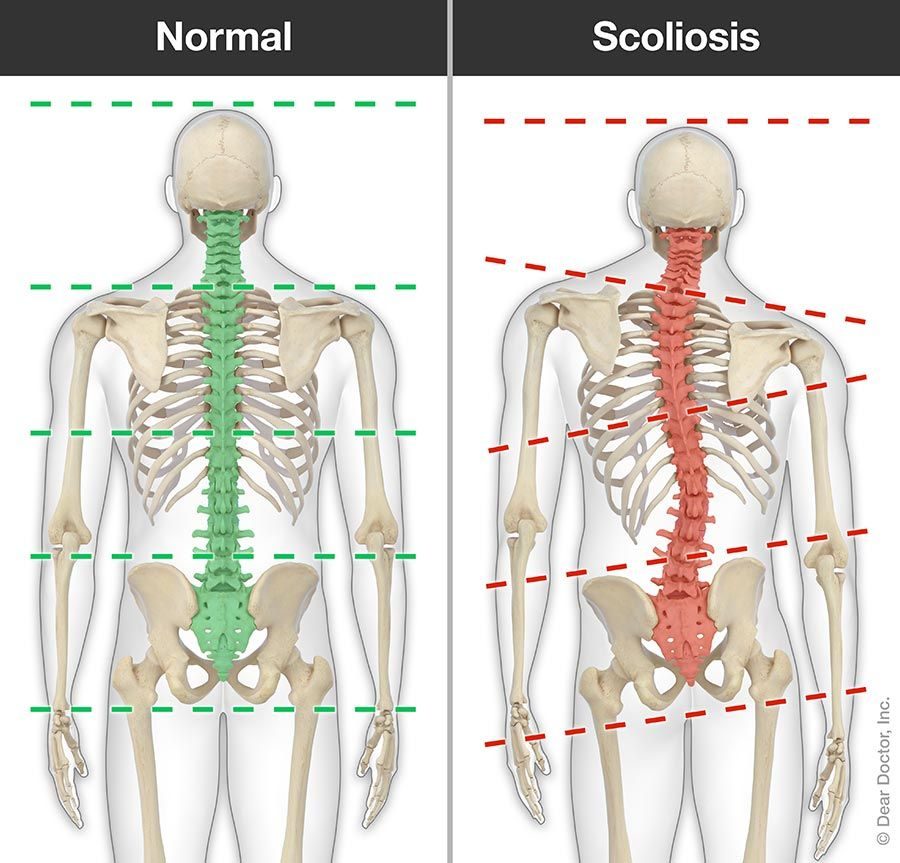
In adults, scoliosis may show up as uneven shoulders or hips, or a shoulder blade that sticks out more on one side. The curve is usually easy to see on an X-ray or other imaging. Many curves are mild, but a large or progressing curve may also cause the spine to rotate. Curves are commonly classified by their angle: under 25 degrees is generally considered mild, 25 to 50 degrees moderate and more than 50 degrees severe. Larger curves are more likely to be associated with symptoms such as:
- Lower back pain
- Stiffness and reduced range of motion
- Pain or numbness caused by nerve compression
- Tiredness resulting from uneven loading of the lower back and legs
Symptoms often increase with age as the spine degenerates, which can make the curve worse. Spinal stenosis, a narrowing of the canal that houses the spinal cord and nerves, may also develop and add to pain and pressure. A severe curve in the middle back can change the shape of the rib cage at any age, which may reduce how deeply a person can breathe.
Some people with scoliosis gradually begin to stoop forward, since bending forward can create more room for spinal nerves and ease pressure and pain. Scoliosis may also flatten the normal inward curve of the lower back, which can contribute to a forward lean. To compensate and stand more upright, some people bend at the hips and knees.
Treatment Approaches
Even a moderate curve may cause the spine to wear down faster than a spine with typical curvature. Addressing scoliosis early, before significant pain develops, may lead to better long-term results. For children and teens whose curves are increasing or causing discomfort, a specially fitted brace may be recommended to help limit progression until growth is complete.
Surgery to fuse the spine may be considered for severe curves, typically those that progress past about 45 degrees in people who are still growing or about 50 degrees in adults. In this operation, metal screws and rods are used to straighten the vertebrae, which then grow together over time. While fusion can produce a straighter spine, it often reduces flexibility and may increase stress on the segments above and below the fused area. Measuring the curve can help a chiropractor determine whether a referral for a surgical opinion is appropriate.
For managing pain related to scoliosis, chiropractic care offers a conservative option that does not rely on medication or surgery. It cannot reverse an abnormal curve, but it may help some patients stay more mobile and experience less pain and fatigue. Spinal adjustments and soft tissue work may help improve posture and reduce strain on the back and legs.
Research on chiropractic care for scoliosis is limited, but some small studies have reported improvements in pain and disability among patients who received this type of care. Larger, well-designed studies are still needed to understand who is most likely to benefit.
Regular chiropractic visits, at a frequency recommended by the practitioner, are a non-invasive way some people manage the day-to-day effects of scoliosis. Adjustments are intended to keep joints moving, and addressing spinal restrictions may help reduce inflammation and improve function. Better mobility and spinal health may help the body cope with the extra stress of a curved spine. Anyone with scoliosis who notices new numbness, weakness, breathing difficulty or rapid changes in posture should seek prompt medical evaluation.